Scotland’s Landscapes Hold the Key to Building a Sustainable Future

The Scottish Geology Trust has launched a Crowdfunding Campaign to kick-start its work after setbacks due to COVID-19

Scotland’s wild, rugged and incredible landscape is loved by millions and has been carved out over billions of years.

It’s thanks to Scotland’s geology that we now understand how our planet works, when it was formed, why climate changes and where it is headed in the future. There really is nowhere else on Earth where you can see such diverse and exciting geology in one country.

The Scottish Geology Trust is a new charity set-up just before lockdown aiming to unite Scotland’s geological groups and communities to inspire people everywhere to understand, love and care for our landscapes.

The Trust is appealing to the public for support for its first Crowdfunding Campaign, which publicly launches Tuesday 3 November aiming to raise £35,000 in five weeks. With funding plans having been curtailed due to the pandemic, urgent support is needed in order to progress crucial plans promoting and protecting Scotland’s geology.

Scotland’s geology has a vital role to play in creating a sustainable future, but the value of this science is often overlooked. It’s time to respond to this gap and campaign for more readily available support and resources for geoparks, geosites, and education.

COVID-19 has depleted many of the funding resources that would have allowed the Trust to deliver planned support for Scotland’s geoparks, museums, education and communities. These plans are more needed than ever for a green recovery.

Melvyn Giles, Chair of the Scottish Geology Trust has said:

“The rocks making up Scotland’s landscapes hold stories going back billions of years – it’s a valuable archive of our planets history and understanding it helps us to understand our impact and potential future on the planet. The Scottish Geology Trust will bring these stories alive so that Scotland can continue to be the birthplace of our understanding of the planet and lead the way in creating a sustainable future. We urge the public to get behind our campaign to help protect our landscapes and our future.”

The charity and Crowdfunding Campaign has already seen backing from the likes of Professor Iain Stewart and Alexander McCall Smith, CBE as both offered their call to arms for Scotland’s geology through the campaign’s video, which can be viewed on the charity’s Crowdfunder page.

The Scottish Geology Trust is appealing to the people of Scotland and across the world, lovers of our landscapes, geologists and those who have benefited from Scotland’s rich culture and resources to consider giving to its first fundraiser. Urgent support is needed for the charity to continue after the pandemic.

To donate now and support the Trust, please visit www.crowdfunder.co.uk/scottish-geology-trust.
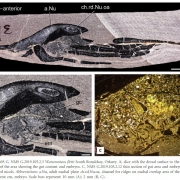
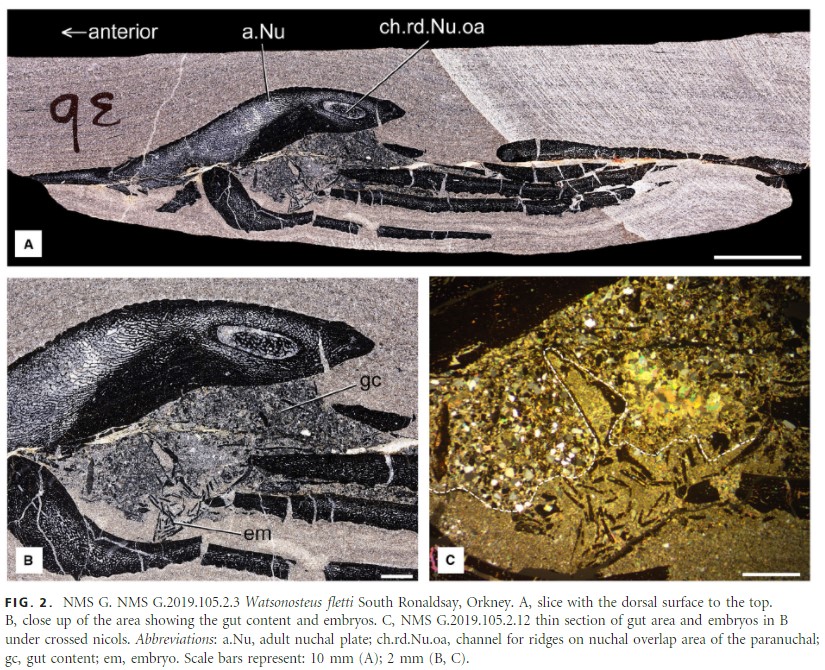
The fossilised remains of an ancient fish discovered in South Ronaldsay, Orkney contain the world’s oldest known unborn embryos. The fish is Watsonosteus fletti (an the arthrodire placoderm) from the Eday Flagstone Formation.

Lead author of the paper, Mike Newman, told BBC Radio Orkney: “We were sectioning just randomly really, and we saw what makes up the bones, even though it is fossilised. And then we went through the body cavity. Inside we found the gut contents. But then there were these strange, very thin, little bones. And it became apparent, by looking at the detail of these bones, that they were actually the young of the adult.”

Image below from the paper published in the journal Palaeontology.

Report on BBC website https://www.bbc.co.uk/news/uk-scotland-north-east-orkney-shetland-54551068

Research paper Earliest vertebrate embryos in the fossil record (Middle Devonian, Givetian) Michael J. Newman, Jan den Blaauwen, Carole Burrow, Roger Jones First published: 24 September 2020

Scotland’s geological heritage has attracted international interest for centuries and with renown sites on our doorstep, even in Scotland’s capital, it was agreed a celebration inviting all to explore these incredible places was well overdue.

The Scottish Geology Festival ran during September and October 2020 and featured both visitor and virtual events across the country. The Scottish Geology Trust invited groups, societies, and geological organisations across the nation to join in this exciting festival where Scottish geology could be shared and made not only accessible but relatable in everyday life. From the extinct volcanoes and building stone of Edinburgh to the UNESCO Global Geopark in the North West Highlands, the Festival demonstrated that geology isn’t just a thing of the past, but a tool for exploring our future.

There are no upcoming events.

For specific event updates or questions, please contact the event organiser directly. Please email project.manager@scottishgeologytrust.org for any festival queries.

Around 1200 million years ago, a massive, 100 metre long rock fell off a low cliff and splatted into the mud below. The rock weighed almost 250,000 tonnes and was made of the ancient Lewisian gneiss basement rock that is found in the North West Highlands of Scotland and the Outer Hebrides. Now, more than a billion years later, the rock is back at the surface at Clachtoll, exposed within the lowest layers of the Stoerr Group of the Torridonian.

A recent paper published in Geology by Zachary Killingback and co-authors presents a detailed analysis of the fallen rock, and the network of cracks that formed as a result of the impact. The cracks on the underside of the rock were forcibly filled with slurry as the rock landed in the mud. But cracks on the upper surface were filled more slowly as the fallen rock gradually got buried in sand.

Zach Killingback carried out this research as a Masters student at the University of Durham. He has autism, and an article describing the research in National Geographic explores some of the challenges of geological fieldwork and research.

Plans approved for Sutherland exhibition centre displaying world renowned collection of stones, minerals and fossils
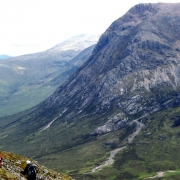
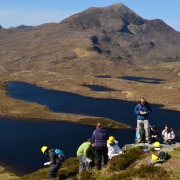
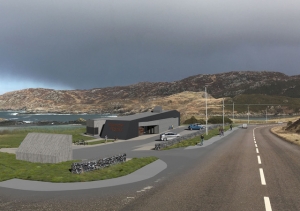
The community of Scourie in the North West Highlands is celebrating after plans for a new exhibition centre and visitor attraction to display one of the foremost collections of rare stones, minerals and fossils, have been approved.

Plans by the Scourie Development Company (SCDC) for a new community managed facility in Scourie, Sutherland, which will display the world-renowned Shelley Collection have been given the green light by the Highland Council this week.

Neil Macdonald, chairman of SCDC and a member of the Scourie Community Council, said: “Scourie Rocks will have a huge impact in the area, providing employment, education opportunities and much needed community facilities. We are delighted it has been approved and we can now look forward to progressing the plans and developing funding package for the centre. The SCDC would like to thank all our consultants who assisted in the development of Scourie Rocks with special thanks to our architect Catriona Hill now of Oberlanders.

Scourie Development Company Facebook page

These hour-long seminars will include a short presentation from an expert, followed by opportunities to discuss the issue and help shape future activities of the Scottish Geology Trust. On Tuesdays at 5.30pm from 4 August.

Scottish Geology Trust - Knockan Crag

The Scottish Geology Trust is now recruiting for a number of volunteer positions to further support its business and development plans. The list of current volunteer roles we are now recruiting for can be found here. We would be especially interested to hear from any of our members or volunteers who have experience in videography and campaign videos.

The Scottish Geology Trust has received a major gift from the Trustees of First Scottish. This donation of £5,000 will support the Scottish Geology Trust with its fundraising efforts and specifically hiring a part-time fundraiser. The Trust is delighted to have this vital support from First Scottish and thanks the Trustees for this generous contribution. Trustee of First Scottish, Hugh Lockhart said, “The creation of a national body to protect and promote Scotland’s unique geology is as welcome as it is long overdue. It is a privilege to contribute to this bold and important undertaking.”

Scottish Geology Trust is in the planning stages of its first fundraising campaign, which will be run as a crowdfunder. As a new charity, it is an especially difficult time to launch, but the Trust believes Scotland’s geology needs support now and is aiming to officially launch in Spring 2021. Our crowdfunder will see a number of vital projects highlighted for support from our members, the geological community and those passionate about Scotland and Scottish landscapes. We look forward to announcing more details about our the campaign soon. If you’re interested in volunteering to help with the fundraising campaign please email project.manager@scottishgeologytrust.org. 

If you or someone you know is interested in applying for the part-time fundraising consultant position with SGT, please get in touch.

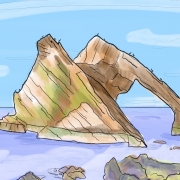
Bow Fiddle Rock

VisitScotland’s Sketching Scotland series celebrates Scotland’s rich history

A new campaign launched by VisitScotland aims to inspire future visitors to Scotland as COVID restrictions ease.

The Sketching Scotland series invites budding artists from across the globe to combine their love of drawing and Scotland to sketch 20 of Scotland’s best-known landmarks via step-by-step art tutorials.

Some of the wonderful landmarks included in the series are: the colourful Tobermory houses at the harbour on the Isle of Mull, the UNESCO World Heritage Site, the Forth Rail Bridge and –  the one that we’re particularly excited about – the awe-inspiring Bow Fiddle Rock in Portknockie on the north east coast of Scotland.  The tutorial provides great advice in helping you to capture the rock’s distinctive sloped sides which was caused by the impact of two ancient continents colliding hundreds of millions of years ago.

Every sketching tutorial provides the viewer with facts about each landmark and offers tips on how to improve your art skills.

It’s the perfect way to also inspire those who have sketched landmarks to visit them in future and once it’s safe to do so.

To get involved, you can view the videos already uploaded as part of the series on VisitScotland’s YouTube channel. If you’re uploading your finished piece of art onto social media, you’re invited to use the hashtag #sketchingscotland and link to VisitScotland’s social accounts: Instagram, Facebook or Twitter.

Find out more about Sketching Scotland.

Two recent research papers demonstrate the contribution that Scotland’s geology continues to make to understanding evolution and extinction.

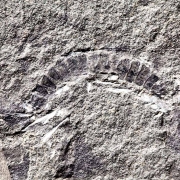
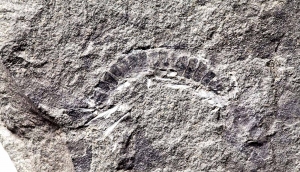
The millipede Kampecaris obanensis from Kerrera, courtesy British Geological Survey

The world’s oldest “bug” – a fossil millipede from the island of Kerrera

New calculations of the age of key sedimentary rocks at two sites in Scotland have clarified the timescales of the change from lake margin communities to the much more complex forest environments of the Devonian period. It only took 40 million years for this transition, a much shorter timescale that molecular clock calculations had suggested.

The new research caculates that lake deposits on the island of Kerrara, which contain a fossil millipede, are 425 million years old; older than a previous record, of the fossil millipede Pneumodesmus newmani that was found at Cowie near Stonehaven by Mike Newman, a bus driver and amateur palaeontologist, now thought to be 414 million years old.

Read the full article (open access) by M. E. Brookfield, E. J. Catlos, S. E. Suarez of The University of Texas at Austin in Historical Biology.

Further information about Pneumodesmus newmani from Cowie (wikipedia).

The late Ordovician mass extinction linked to volcanic activity

Just 20 million years earlier, life in the oceans had suffered a significant mass extinction with the loss of 85% of species. This late Ordovician mass extinction was thought to have a different origin than other mass extinctions in geological history, that are associated with global warming related to large-scale volcanic activity. Recent research of the rocks at Dob’s Linn in the Southern Uplands has changed that, by detected evidence of a spike in mercury levels, which combine with other evidence to suggest that sustained volcanic activity and oceanic anoxia.

Read the full article (open access) by David Bond (University of Hull) and Stephen Grasby (Geological Survey of Canada) Late Ordovician mass extinction caused by volcanism, warming, and anoxia, not cooling and glaciation, Geology 2020.