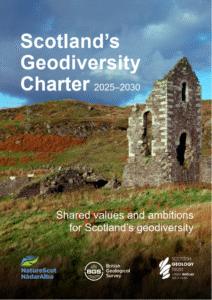
 Scotland’s Geodiversity Charter 2025–2030
Shared values and ambitions for Scotland’s geodiversity
Download Scotland’s Geodiversity Charter 2025-2030 (pdf file)
Scotland’s Geodiversity
Scotland’s world-class geodiversity has a profound influence on Scotland’s landscape, economy, historical and cultural heritage, education, health and well-being. It is the foundation underlying our habitats and species, and plays an important role in helping address biodiversity loss. Geodiversity helps us understand Earth’s history, providing knowledge to help society mitigate and adapt to climate change and sea level rise.
Geodiversity is the part of nature represented by the variety of rocks, landforms, sediments and soils, and the natural processes which form and alter them.
Elements of our geodiversity such as iconic landscape features, important fossil and mineral sites, rivers and coastal features, that have significant intrinsic, cultural, aesthetic, scientific or educational value, are collectively known as our geoheritage.
Previous editions: Scotland’s Geodiversity Charter 2012-2017 | Scotland’s Geodiversity Charter 2018-2023
Foreword
 Gillian Martin MSP, Cabinet Secretary for Climate Action and Energy
The geodiversity of any place is unique and of intrinsic interest and importance but, because of our rich historical tradition of scientific endeavour, Scotland’s geodiversity also underpins the global understanding of geodiversity and our planet’s systems. So much so that some of our most celebrated geologists, James Hutton and Hugh Miller for example, are all but household names.
Today, geodiversity provides the backdrop for our magnificent landscapes, from the Old Man of Hoy to Smoo Cave, from Fingal’s to Arthur’s Seat, making Scotland one of the most celebrated and recognisable countries on Earth. Geodiversity is also an integral part of Scotland’s natural environment, shaping our mountain ranges, rivers and burns, our coastal cliffs, beaches and our sea beds and the species that inhabit them.
Scotland’s Geodiversity Charter, since its formulation in 2012, has been inspirational and truly world leading. Over two iterations, the Charter has been successful in securing wider appreciation of the multi-functional nature of geodiversity and its role and value to society. This refresh of the Charter, refocussing and redeveloping to address new challenges and additional needs in consultation with the community of interest behind the Charter, will enable us to more fully realise geodiversity’s part in dealing with climate change and biodiversity loss.
The refreshed Charter will continue to play an essential role in highlighting the value of Scotland’s remarkable geodiversity and the range of geosystem services it provides. Embedding of the Charter in the Scottish Biodiversity Delivery Plan 2024–2030, emphasises, unequivocally, the essential role that geodiversity plays in delivering for biodiversity and helping to mitigate for the effects of climate change.
The Charter and the case studies it presents demonstrate in a compelling way the role and value of Scotland’s geodiversity which I am confident will encourage wider support and action in achieving the Charter’s vision. Doing so will enable our worldclass geodiversity to better work for Scotland helping improve people’s health and well-being and continue to provide essential benefits for current and future generations.
The Evolution of Scotland’s Geodiversity Charter
Scotland’s Geodiversity Charter was first launched in June 2012, and is supported by the Scottish Government. It was intended, at the outset, for the Charter to be a time-limited document subject to periodic review to address new challenges and additional needs. A revised Charter was launched in 2017 gaining the support of more than 90 signatory organisations. Over the lifetimes of these first two versions, the Charter has been successful in securing wider appreciation of the multi-functional nature of geodiversity and its role and value to society.
As an integral part of the natural environment, Scotland’s geodiversity cannot be taken for granted. It is a common misconception that geological features are sufficiently robust and do not require conservation or active management. The loss or mismanagement of geodiversity, as a consequence of unsustainable or misguided development, or changing land use or climate change, not only devalues our geoheritage but also presents real threats to biodiversity and can result in significant economic and social costs (e.g. enhanced coastal erosion or flooding).
Scotland’s Geodiversity Charter for 2025–2030 will recommit to the championing of geodiversity’s role in the delivery of valuable geosystem services, helping build a resilient and sustainable future in a rapidly changing world.
Ongoing active consideration of geodiversity at a strategic level will help delivery of National Outcomes set out in the Scottish Government’s National Performance Framework.
The sustainable management of geodiversity and promotion of its importance and value can have very positive economic, social, cultural, educational and public health benefits. The importance of Scotland’s geodiversity in underpinning our distinctive landscapes is also recognised in Scotland’s Landscape Charter. Recognising geodiversity can help inform effective action on climate change and biodiversity recovery.
Integration of geodiversity into wider environmental policy and decision frameworks, such as the National Planning Framework, is vital. An inclusive approach not only helps conserve vulnerable elements of our geoheritage, but also ensures more holistic conservation management of biodiversity, geodiversity and landscape through the ‘ecosystem approach’ advocated by the Scottish Biodiversity Strategy to 2045.
Geodiversity has a clear and essential part to play in dealing with societal challenges, including sustainable economic development, changes in climate and sea-level, loss of biodiversity and improving people’s health and well-being.
As Scotland faces the nature-climate crisis, promotion of the Geodiversity Charter and raising awareness of the role of geodiversity in the delivery of valuable geosystem services, is increasingly vital.
A vision for Scotland’s Geodiversity
Scotland’s Geodiversity Charter encourages the promotion and appropriate management of Scotland’s geodiversity. It seeks greater integration of geodiversity into policy, planning and guidance that is consistent with the economic, social, cultural and environmental needs of Scotland. This will help to ensure that, as a crucial aspect of our natural heritage, geodiversity continues to provide benefits for current and future generations.
The shared vision of the signatories to this Charter is that Scotland’s geodiversity is universally recognised as an integral and vital part of nature, our environment, economy, heritage and future sustainable development.
As a community of interest, we commit to maintain, enhance, promote and protect our geodiversity as an integral part of nature, acknowledging and realising its contribution to:
- Scotland’s remarkable and internationally recognised geoheritage and landscape;
- historical and cultural development, its role in place making, intellectual growth and creative expression;
- sustainable economic development and essential benefits for society;
- underpinning support for biodiversity and addressing biodiversity loss;
- informing nature-based solutions for adaptation to changes in climate and sea-level;
- public physical and mental health, quality of life, national well-being and reconnecting people with nature.
Achieving our vision — aims
The Charter encourages determined and collective action from all sectors—public bodies, industry, landowners and managers, academics, teachers, voluntary organisations and individuals—to fulfil our vision. This will ensure that our geodiversity is adequately considered and conserved, and continues to provide essential benefits for Scotland.
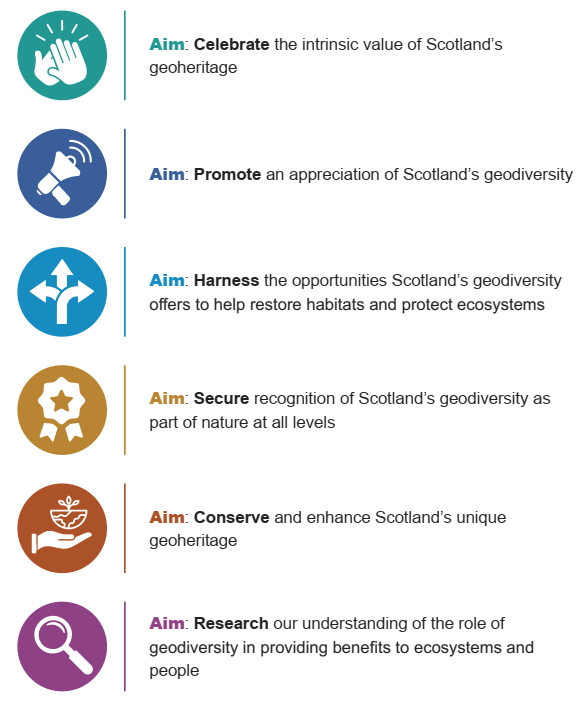
Aim: Celebrate the intrinsic value of Scotland’s geoheritage
Case study
Arran UNESCO Global Geopark: realising the benefits of world-class geodiversity
Arran Geopark has recently been awarded UNESCO Global Geopark status, recognising the island’s internationally significant geological heritage. It is not just the island’s incredible geodiversity that has contributed to this recognition; UNESCO Global Geoparks must join the dots between their unique geoheritage and the community, the landscape, biodiversity, culture, and intangible heritage.
To achieve this for visitors and for locals, there are waymarked trails around the island that lead to important geological sites. Guided walks and geo-kayak tours get people outdoors, and Gaelic in the Landscape walks focus on integrating local history and culture. Geopark partner organisations welcome school groups and universities from across the United Kingdom. The National Trust for Scotland Ranger Service offers a popular introduction to Arran’s geology for local schools, during which pupils take on geological dress; as volcanoes, underwater, the tropics, and the ice age! The
Geopark’s boundary doesn’t end at the beach, but extends offshore to three nautical miles. Working with the Arran Seabed Trust (COAST), snorkel trips for adults and older children explore the life normally hidden under the sea, and seashore backpacks provide useful equipment for coastal exploration.
Geodiversity, forms the foundation, both literally and metaphorically, of what makes Arran a special place to visit and to live. Through the many activities taking place on the island locals and visitors can connect with their geoheritage in myriad ways, and learn more about the landscape that sustains them.
Adapted from text by Malcolm Wilkinson, Arran Geopark.
Aim: Promote an appreciation of Scotland’s geodiversity
Case study
Evidence from Earth’s deep past: lessons in climate change
Research on the Garvellach islands and Islay reveals details of a climate crisis in Earth’s deep past that threatened all life on the planet. A magnificent cross-section through the bedrock records the onset of a time of glaciation often referred to as Snowball Earth. This happened during the Cryogenian, 720–635 million years ago, when Scotland lay much further south in tropical latitudes.
The series of rocks known as the Port Askaig Formation records an extraordinary number of features produced during global cooling and glaciation. This includes spectacular slabs or ‘rafts’ of bedrock, which were ripped up by the ice as it moved.
The fascinating geology not only tells us this incredible story, but has direct relevance to the modern world. To appreciate how enormous climatic shifts may effect biodiversity and Earth processes in the
future, we need to look to our own history, and the geological record is crucial for this. Such geodiversity is of global significance and is rightfully recognised and celebrated; the Garvellachs are a prime candidate for a global ‘golden spike’, an important reference point in geology, marking the start of the Cryogenian and Snowball Earth.
Adapted from text by David Webster.
Aim: Harness the opportunities Scotland’s geodiversity offers to help restore habitats and protect ecosystems
Case study
Restoration of the Cattie Burn: re-establishing natural river processes to support ecological diversity
The Cattie Burn is an important tributary of the River Dee and designated as a Special Area of Conservation for Atlantic salmon, freshwater pearl mussel and otter. Like many Scottish watercourses, large sections of the Cattie Burn have historically been modified and straightened, significantly affecting dynamic natural river processes. This has altered the physical nature of the Burn, preventing it from connecting with its wider floodplain, and stunting its ecological diversity.
The aim of this project, developed and managed by the Dee District Salmon Fishery Board, was to improve river habitat and restore vital natural river processes. It involved re-creating a 750m long sinuous channel, similar to the river’s original meander. Tree trunks and other wooden structures were added to mimic natural conditions, trapping sediment and providing shelter for aquatic life.
This work was carried out alongside a large catchmentwide programme of changes, including the removal of two redundant man-made weirs, installation of large wood structures, leaky dams, tree planting, riparian (river-bank) fencing and wetland creation. By improving the capacity of the Cattie Burn to support a healthy and diverse ecosystem, it will also be more resilient to flooding and the other impacts of climate change.
Adapted from text by Edwin Third, Dee District Salmon Fishery Board.
Aim: Secure recognition of Scotland’s geodiversity as part of nature at all levels
Case study
Dynamic coast: helping dynamic geodiversity processes help us adapt to climate change
Over the past decade the Scottish Government’s Dynamic Coast project has helped local authorities and government value our coastal geodiversity, and begin adapting to future climate and coastline changes.
Initiated in 2015, the project provides robust evidence for how our coasts are changing, including the way coastal processes, including wind, waves and tides, change our coastlines through sediment movement and erosion. How these processes operate is linked to the underlying bedrock. Research looked at past change, and identified how conditions will alter by the year 2100 under a range of climate scenarios. Of particular interest are ‘soft’, wave-dominated shores across the Scottish mainland and inhabited islands, which are more susceptible to erosion. Coupled with the impacts on road, rail and building infrastructure, it was estimated that at least £1.2 billion of assets are at risk from erosion by 2050. Hopefully, this could
be reduced by two-thirds if we are able to curb global carbon emissions. The work highlights that adaptation is as essential as mitigation as we face a future with climate change.
In response, the Scottish Government launched the Coastal Change Adaptation Fund. This allocated £11.7 million to local authorities between 2022 and 2026 to help them develop Coastal Change Adaptation Plans. Understanding coastal geodiversity is fundamental to adapting and securing a sustainable future.
Adapted from text by Alistair Rennie, NatureScot.
Aim: Conserve and enhance Scotland’s unique geoheritage
Case study
The Geosites project: voluntary geodiversity conservation and promotion in action
Scotland has over 1300 sites that are designated as important for geology and geomorphology (the processes that shape landscapes) at a national or local level. It can be difficult to access and understand information about them, and systematic monitoring is under-resourced. As a result, many sites go unrecognised, and may not be protected from damage and loss.
The Scottish Geology Trust’s Geosites project has created a website with an easy-to-use map interface. This brings together information about all of the sites in one place, making it easier for people to share knowledge and report issues. Volunteers are contributing data to the Geosites map, adding details about the condition of the site, links to sources of further information, and useful notes on access and safety. They have also added thousands of photographs, creating a record of key features and how these are changing over time.
The Geosite project promotes a strong geoconservation message, encouraging people to respect the sites and report problems. This has led to the identification of a small number of issues, including reports of illegal collecting
and site damage, along with problems like overgrowth of vegetation. This work complements the existing site monitoring programme carried out by NatureScot, who have recognised its usefulness, and the Scottish Geology Trust has since worked with colleagues at NatureScot to take action as appropriate.
Adapted from text by Dr Elsa Panciroli, Scottish Geology Trust.
Aim: Research our understanding of the role of geodiversity in providing benefits to ecosystems and people
Case study
Considering geodiversity: benefits and safeguards for biodiversity
Understanding the relation between geodiversity and biodiversity is crucial for effective conservation planning. This can be seen clearly in mountain habitats, where research shows that geodiversity influences plant species distributions. The Cairngorms is a high-level Arctic plateau with deep valleys carved by glaciers. Different soils that have formed there, with unique mineral and nutrient combinations, support different plant and animal species. Landforms like ridges and hollows create microclimates, while dynamic processes like slope movement form habitats, and rivers and lakes shape and connect the landscape.
The heath dog-violet (Viola canina) for example, is linked to clay-silica valleys and boggy slopes, whereas the mossy saxifrage (Saxifraga hypnoides) prefers steep slopes. Black alpine-sedge (Carex atrata) inhabits mountain hollows and valleys. These species are intimately linked to the shape of the landscape and the soil content, and support specific species of insect and other animals. Without the varied mountain habitats to support them, the ecosystem would be much less biodiverse.
This highlights the need to integrate geodiversity into biodiversity and conservation models and planning. By explicitly considering geodiverse areas and unique geological features, we can ensure that a wide range of physical conditions are conserved. This approach is especially important for providing resilience and adaptability as the climate changes.
Adapted from text by Dr Joseph Bailey, Anglia Ruskin University.
International recognition of geodiversity
There is international recognition of the value of geodiversity and growing support for its conservation. The International Union for Conservation of Nature (IUCN) acknowledge that geodiversity is part of natural diversity, and that geoheritage is part of natural heritage (Resolutions WCC 2008 RES 040 and WCC 2012 Res 048).
Geological heritage constitutes a natural heritage of scientific, cultural, aesthetic, landscape, economic and intrinsic values, which needs to be preserved and handed down to future generations.
The IUCN also acknowledges the scientific, cultural, aesthetic, landscape, economic and intrinsic values of geoheritage and the relevance of geodiversity in underpinning biological, cultural and landscape diversity. The Recommendation of the Committee of Ministers of the Council of Europe (2004) is that:
IUCN Resolution WCC-2020-Res-074 “ENCOURAGES national Member organisations, other nature conservation organisations, civil society, academia and managers of protected areas and outstanding underground sites to:
a) foster knowledge about geodiversity and geoheritage inside and outside protected areas and to integrate nature conservation principles and methods into the management of protected areas to ensure the effective protection of this component of natural heritage
b) and establish or improve national legislation concerning the protection of geoheritage, enabling the necessary conditions to ensure the implementation of effective conservation measures”
The IUCN has also produced Guidelines for Geoconservation in Protected and Conserved Areas.
The United Nations Organisation for Education, Science and Culture (UNESCO) also recognises the importance of geodiversity with the creation of UNESCO Global Geoparks in 2015. This is the first new UNESCO designation of its kind to be established in over forty years and puts Global Geoparks alongside UNESCO’s World Heritage Sites in terms of importance.
Scotland’s UNESCO Global Geoparks have a role to play in raising community awareness of the role and value of geodiversity in helping to mitigate the effects of climate change, supporting biodiversity and demonstrating environmentally responsible organisation.
The intrinsic value and importance of Scotland’s geodiversity
Scotland has been shaped by over 3 billion years of the Earth’s history; the movements of tectonic plates, mountain building, volcanic activity, glaciation, climate and sea-level changes, erosion and deposition. This has created remarkably rich geodiversity, both on land and offshore, on the surface and in the subsurface. The rich variety of fossils contained in Scotland’s rocks has contributed significantly to our knowledge of the evolution of life.
In many settings biodiversity is strongly influenced by geodiversity, particularly in active rivers, coasts, and in areas where soils are thin. Consequently, responsible management of geodiversity interests can profoundly influence biodiversity.
Scotland is the cradle of geological science, with many major theoretical and technical advances being made through the observation of our rocks and landscapes. Our geodiversity is renowned worldwide, delivering a substantial contribution to global geoheritage.
Together, these elements of geodiversity record the history of the planet, as in the pages of a ‘great stone book’, and form part of our natural heritage to be passed on to future generations.
Scotland’s geoheritage links people, cultures and landscapes. It comprises part of our ‘sense of place’ and has been a powerful influence on cultural and intellectual development, as a source of inspiration for art, sculpture, music, poetry, literature, cinema and science. The great variety of rocks drove the Industrial Revolution in Scotland, determined its geography and land use, and shaped the variety of built environments reflecting the use of different building stones. Geodiversity is the fundamental determinant of the character of our valued landscapes, cityscapes and seascapes.
As a rich resource for education and research, Scotland’s geodiversity lends itself to cross-curricular learning through the Curriculum for Excellence, and provides opportunities for lifelong learning. It is the setting for diverse recreation and outdoor activities that contribute to the economy and people’s health and well-being.
Tourism, a vital component of Scotland’s economy, is strongly founded on geodiversity. Visitors come to enjoy world-class scenery, distinctive history and culture, and an outstanding natural environment. Scotland’s geoparks, developed by their local communities and including UNESCO Global Geoparks, are beacons of innovation that demonstrate how awareness and promotion of geodiversity and heritage can contribute to local economies. While geological tourism in Scotland is relatively small in scale at present, there is potential to market Scotland as ‘the home of geology’, and existing attractions such as whisky distilleries are already rooted in local geology and landscape.
On land and offshore, geodiversity makes a signification contribution to Scotland’s economy as a source of energy and materials. It plays a critical role in the exploration and production of mineral resources, the development of new technologies and industries (e.g. Carbon Capture & Storage and geothermal energy), the location of wind and hydro power resources, infrastructure development, waste storage and remediation of pollution, and provision of fresh water.
Case study Edinburgh volcanoes: celebrating globally important geological and landscape icons
Edinburgh has a unique cityscape thanks to the presence of extinct volcanos: Castle Rock and Arthur’s Seat. Last active 340 million years ago, these geological features have shaped the development and history of Scotland’s capital for over a thousand years, and continue to be valuable for tourism, leisure and education.
Castle Rock is the summit upon which Edinburgh Castle sits. It is the leading edge of a crag-and-tail feature: a tapering slope created by the action of ice sheets as they moved across the landscape during the ice ages. The slope forms the Royal Mile and has defined the city for centuries. The dramatic remains of Arthur’s Seat and the adjacent Salisbury Crags overlook the Scottish Parliament. It was at the base of the Crags that in the 18th Century that the father of geology, James Hutton, first identified important geological processes. Arthur’s Seat and the Crags sit within Holyrood Park, and are an invaluable green space used for education, leisure and physical exercise, and an important home for biodiversity.
The presence of these geological features in the middle of the capital presents geoconservation challenges. Ways must be found to keep the rocky cliffs and summit accessible for leisure, education and research. Geology is crucial to the economic success of Edinburgh, and central to the wellbeing of locals and visitors alike.
Adapted from text by Maarten Krabbendam, British Geological Survey.
Geodiversity, ecosystem services and nature-based solutions
Scotland’s geodiversity represents abiotic (non-living) nature, and this underpins biodiversity. Our nationally and internationally important terrestrial and marine habitats, species and ecosystems exist upon a mosaic of landforms, soils, water, and natural processes. Thanks to these natural assets, Scotland derives a wide range of tangible and intangible benefits, often called ‘ecosystem services’. These are classified along functional lines into four categories: ‘Provisioning services’; ‘Regulating services’; ‘Supporting services’; and ‘Cultural services’.
Securing recognition for the ecosystem services provided by our natural geodiversity resources has given rise to the term ‘geosystem services’. These provide goods and services connected to geodiversity, including construction materials, flood control, habitat provision and geotourism.
Peatlands cover 20% of Scottish land and are part of our Geodiversity as well as supporting great biodiversity. The conservation and management of these systems is key in minimising carbon release. Geodiversity is therefore key to Scotland’s National Peatland Plan.
Geodiversity is not only about the past, but is essential to our lives today. It contributes to human well-being through cultural and aesthetic values, outdoor activity, and other economic and environmental benefits for society. It enables a better understanding of the geological processes that will continue to shape our world in the future.
Understanding the landscape in which we live—of erosion and deposition, dynamic rivers, or coastal and slope processes—comprises a vital part of nature-based solutions to managing our changing environment, particularly in the face of the climate change crisis and biodiversity loss. Soils and estuarine and coastal sediments store large amounts of carbon, making them an important consideration in climate change mitigation.
Geodiversity contributes crucial evidence for evolution of life and development of planet Earth. This is so fundamental that it constitutes a fifth category of ecosystem services: ‘Knowledge services’.
Case study Geodiversity and power: renewable energy from old coal mines
Underneath much of central Scotland lie coalfields, formed between 359 to 299 million years ago when Scotland was covered by vast swaps and forests. For many years, this coal was mined to provide a reliable energy source to power industry and heat our homes, however its usage released large amounts of carbon dioxide into the atmosphere, contributing to climate change. Alternative energy sources are needed to secure a sustainable future for all.
Historic coal mining has left behind abandoned and flooded mines throughout the country. The water in these mines is naturally warmer thanks to being underground, and presents an opportunity to produce clean renewable energy. The British Geological Survey has created a research facility called the Glasgow Observatory, to investigate the use of mine water in tunnels under Rutherglen for heat energy and heat storage purposes, and to pioneer the use of this technology. Mine water can be pumped via boreholes to the surface, where heat pumps transfer and concentrate the heat present in the mine water, raising it to a temperature suitable for heating homes.
Around 25% of UK homes and businesses are located above abandoned coal mines. This means mine water energy has the potential to transform part of our industrial geoheritage into a means of powering our sustainable future. Technology like this demonstrates the value of geodiversity in achieving sustainability, and will help us reach net zero in the future.
Adapted from text by Vanessa Starcher, British Geological Survey.
Helping achieve the vision—a role for everyone
Individuals and communities
Promote the importance and value of your local geodiversity and landscapes. Join a local geology or geoconservation group, start your own group, or volunteer to help in one of Scotland’s UNESCO Global Geoparks. You can:
- Raise awareness of the importance of geodiversity and its links to local landscape and culture.
- Provide information on your local geodiversity to local authorities, encouraging integration of geodiversity in planning decisions and the designation of Local Geodiversity Sites.
- Undertake practical restoration and maintenance work to help geodiversity in your area, particularly within Local GeodiversitySites and Sites of Special Scientific Interest (SSSIs). Activities could include integrating geodiversity in other nature conservation work, and recording geodiversity features at risk of loss.
Land owners and managers
Take into account the geodiversity of the land you manage and try to work in sympathy with any natural river and coastal processes and landforms. Consider how geodiversity can be appreciated on your land. You can:
- Help reverse biodiversity loss and mitigate for the effects of climate change by incorporating consideration of geodiversity and working with natural processes into your management practice, and existing nature conservation activities or policies.
- Ensure you are aware of and maintain geodiversity features of international, national or local importance on your land.
- Help local communities and schools to access and appreciate the connections between geodiversity, land use, history and biodiversity, and encourage safe and responsible access to sites.
- Support responsible geodiversity research, and ensure important sites are accessible and safe for study.
- Seek information and advice to help you understand what you can do to manage and enhance geodiversity.
Industry and business
Ensure that new developments aim to maintain and enhance geodiversity and provide long-term, safe access to internationally, nationally and locally important sites of interest for education, tourism and enjoyment. You can:
- Prepare a company Geodiversity Action Plan and contribute to geodiversity work carried out by Local Authorities, including site audits and action plans.
- Work with natural processes as far as possible, and consider the ‘geosystem services’ provided by geodiversity when planning new developments.
- Support efforts to encourage public awareness and enjoyment of geodiversity.
- Be aware of any geodiversity features of international, national or local importance when planning development and seek advice on minimising impacts.
- Develop sustainable businesses using and inspired by geodiversity, including tourism, guiding and interpretation and local arts and crafts.
- Facilitate access to geodiversity features including temporary exposures and make available records and samples as part of local and national geological record keeping.
Local authorities, public agencies and Scottish Government
Embed the unifying definition of nature that incorporates geodiversity, and make use of the services it offers to help restore habitats, protect ecosystems and help mitigate the effects of climate change. Doing so will ensure that due consideration, management, enhancement and promotion of geodiversity and our geoheritage, including Local Geodiversity Sites, are an integral part of decision making. You can:
- Continue to acknowledge the value and importance of geodiversity in policy and guidance at national and local level and seek advice from appropriate expert bodies and agencies in decision making.
- Consider geodiversity and geoheritage when developing National Planning Frameworks, other national planning guidance and in the creation of local Development Plans.
- Form partnerships with local geoconservation groups and involve communities in selecting and auditing Local Geodiversity Sites.
- Ensure that local communities and geoconservation groups are integral to decision making concerning Local Geodiversity Sites, and have a role in the development of Local Geodiversity Action Plans.
- Promote Scotland’s geodiversity and importantly support our UNESCO Global Geoparks as valuable national assets that provide a sense of place for local communities and add value to visitor experience and enjoyment.
- Ensure geodiversity and geoheritage are considered when exercising statutory duties.
- Encourage developers to allow access to temporary geological exposures to record and sample, and to contribute borehole and other
factual geological data to the British Geological Survey.
Schools, research institutions, museums and science centres
Share and promote the values and applications of Scotland’s geodiversity through formal education, informal educational programmes, public outreach and world-class research. You can:
- Inspire teachers and learners at all levels about Scotland’s geodiversity and its wider links.
- Develop the use of Scotland’s geodiversity in outdoor learning in an Earth and environment context.
- Improve access to, and encourage better use of, existing information and data (e.g. through Scotland’s environment website).
- Influence decision makers on the restoration of Earth Science to the curriculum and support and develop outreach activities for the general public.
- Promote geodiversity, and it being part of nature, at a policy level, and share research evidence demonstrating geodiversity’s wider benefits, values and multiple applications.
- Support local geoconservation groups and local authorities in designating Local Geodiversity Sites and uphold the Scottish Outdoor Access Code and other codes and advice about fieldwork and collecting.
- Develop the scientific and theoretical framework of geodiversity and address key knowledge gaps, including geodiversity’s functional links with biodiversity and our knowledge of marine geodiversity and its wider significance.
Signing the Charter
The following organisations have signed this Charter, agreeing to support the vision and work towards relevant actions:
National organisations
- Action to Protect Rural Scotland
- Atlantic Salmon Trust
- Bat Conservation Trust
- Botanical Society of Scotland
- British Geological Survey
- British Society for Geomorphology
- English Geodiversity Forum
- GeoConservation UK
- James Hutton Institute
- John Muir Trust
- Landscape Institute Scotland
- Mountain Training Scotland
- Mountaineering Scotland
- National Museums Scotland
- National Trust for Scotland
- Nature Scot
- Plantlife Scotland
- Quaternary Research Association
- Ramblers Scotland
- Royal Scottish Geographical Society
- Scottish Association of Geography Teachers
- Scottish Centre for Geopoetics
- Scottish Environment Protection Agency
- Scottish Geology Trust
- Scottish Lime Centre Trust
- Scottish Mineral and Lapidary Club
- Scottish Tourist Guides Association
- Scottish Wild Land Group
- The Froglife Trust
- The Geological Society
- The Geologists’ Association
- The Palaeontographical Society
- The Palaeontological Association
- Visit Scotland
- Wester Ross Biosphere
Universities
- Edinburgh Napier University
- Heriot-Watt University
- School of Earth & Environmental Sciences, University of St Andrews
- School of GeoSciences, University of Edinburgh
- Scottish Association for Marine Science
- University of Glasgow
- University of the Highlands and Islands
Local authorities/ regional organisations
- Aberdeen Geological Society
- Angus Council
- Arran Geopark
- Cairngorms Campaign
- Cairngorms National Park Authority
- City of Edinburgh Council
- Dynamic Earth
- Earth Science Society, University of Glasgow
- East Dunbartonshire Council
- Edinburgh Geological Society
- Geological Society of Glasgow
- Glasgow City Council
- Highland Geological Society
- Loch Lomond & the Trossachs National Park
- Lochaber Geopark
- North West Highlands Geopark
- Orkney Islands Council
- Perth and Kinross Council
- Shetland Amenity Trust
- The Highland Council
- West Lothian Council
Community
- Friends of Hugh Miller
- Friends of Kelvin Valley
- GeoBus
- Geodiversity: Argyll & the Islands
- geoHeritage Fife
- Grampian Speleological Group
- Lochranza Centre CIC
- Lothian and Borders GeoConservation
- Mull Historical & Archaeological Society
- Shetland Geological Society
- St Andrews Open Learning
- Strathclyde Geoconservation
- Tayside Biodiversity Partnership
Commercial
- BioGeoD
- Breedon Northern Ltd
- EnviroCentre Ltd
- Geowalks
- Hamlet Mountaineering
- Hills of Hame
- Mr Wood’s Fossils
- Selkie Ventures
- Wilco Geotechnics Ltd
- Wilderness Scotland
Signing the Charter
Organisations are encouraged to sign the Charter, contact chair@scottishgeologytrust.org for more information.
Support and Guidance
Geodiversity & Geoconservation
Scottish Geology Trust – www.scottishgeologytrust.org/geology/geoconservation/
NatureScot – www.nature.scot/landforms-and-geology/importance-geodiversity
British Geological Survey – www.bgs.ac.uk/geological-research/nationalgeoscience/
Geoconservation groups
Geodiversity: Argyll and the Islands
This publication should be cited as: Scotland’s Geodiversity Charter (2025–2030). Scottish Geology Trust and British Geological Survey, 2025 – www.scottishgeologytrust.org/charter/.