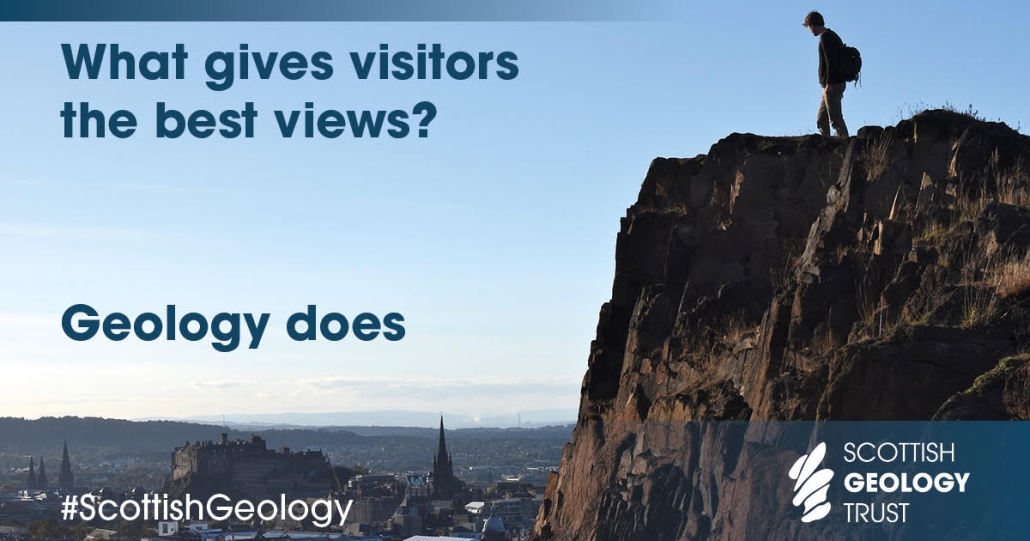
The Scottish Geology Trust’s Geology does campaign celebrates the contribution geology makes to Scotland. It’s the country’s bedrock; it tells Scotland’s story; it resources our future. The campaign launches on Wednesday 23 November 2022 at Science and the Parliament event, and from 24 November across our social media channels.

www.scottishgeologytrust.org/geology-does/

The campaign consists of a series of eye-catching images alongside simple questions and provocations, with the response: ‘Geology does’.

Support from diverse partners to share, amplify and interpret the campaign in ways that are useful to your own work is welcomed and invited.

Two geological sites in Scotland have been recognised by the International Union of Geological Sciences in a list of the First 100 Geological Heritage Sites. These are sites of significant international scientific relevance, making a substantial contribution to the development of geological sciences.

The two Scottish sites are Siccar Point, near Dunbar and the Moine Thrust Zone in the North West Highlands.
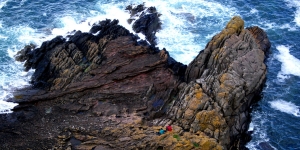
Siccar Point is a spectacular rocky promontory on the coast of the Scottish Borders, 10 miles south-east of Dunbar. It is commonly recognised as the most important geological site in the world. Siccar Point was first described in 1788 by James Hutton and his friends as an example of an angular unconformity – a junction between two sets of rocks of different ages. Hutton’s descriptions of these rocks revolutionised science – providing a first glimpse of “deep time” and the great cycles in earth history. Siccar Point is widely regarded now as one of birthplaces of the science of geology and Hutton as the science’s father-figure. Although the site is little known locally, it has inspired scientists and students for centuries – and fundamentally changed the way we see the Earth.
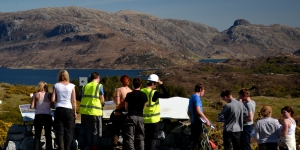
The Moine Thrust Zone is a major tract of ancient tectonic faulting where rocks have been moved more than 100 km sideways. It can be traced from Cape Wrath, on Scotland’s north coast south to the Isle of Skye, and constitutes not only the centrepiece to the NW Highlands UNESCO Geopark but also its landscapes are the highlight of the NorthCoast 500 tourist trail. Recognised in the 19th century, the Moine Thrust Zone revolutionised the ways geologists developed tectonic understanding of ancient and modern mountain ranges around the world.

Prof Robert Holdsworth (Chair of the Scottish Geology Trust) said: “There is a very strong argument that says that the science of geology came into being from observations first made in Scotland. These are places where humankind made gigantic conceptual leaps forwards in our understanding of Earth processes and the passage of geological time. Such extraordinary and visually captivating localities are an inspiration to current and future geoscientists worldwide and are the centrepiece of what makes the rocks of Scotland so special.”

Professor Iain Stewart (UNESCO Chair in Geoscience & Society, Scottish geologist & BBC documentary maker) said: “Siccar Point is a sacred pilgrimage place for geologists the world over – an apparently unassuming rocky foreshore in which the full enormity of geological time is laid out in the tilted strata of the planet’s natural convulsions. The Moine Thrust Zone gave geologists a new way of seeing how mountains formed – slices of ancient strata, stacked up on top of each other, creating Himalayas-scale peaks that have been worn down to their roots.”

The Scottish Geology Trust welcomes the inclusion of two important sites in the First 100 Geological Heritage Sites; we are working to promote these sites and Scottish geology, and to highlight the opportunities for internationally recognised sites to contribute to local economies. The Trust works to raise awareness of UNESCO Global Geoparks in Scotland, and their potential contribution to achieving Scottish Government outcomes for National Parks, Regional Land Use Partnerships and green jobs.

The Scottish Geology Trust online seminar Promoting Scotland’s Geology – the First 100 Geological Heritage Sites takes place on Friday 28 October, 4pm. All welcome!

NatureScot is seeking views on the updated and refreshed Scottish Fossil Code which is due for relaunch in early 2023. To ensure that the refreshed Code is understandable and caters for all those that have an interest in Scotland’s fossil heritage NatureScot is inviting comments and advice at The Scottish Fossil Code – have your say page. Please note that the closing date for this consultation is Thursday 17th November 2022.

The Nature Conservation (Scotland) Act 2004 required Scottish Natural Heritage, now known as NatureScot, to prepare the Scottish Fossil Code. The requirement is in recognition of the value and vulnerability of Scotland’s fossil heritage and that legislative measures alone cannot entirely safeguard the fossil heritage.

The Code provides essential information on the nature of Scotland’s fossil heritage and the need for its appropriate management and safeguard. It is aimed at everyone with an interest and involvement in the fossil heritage and outlines the roles and responsibilities of those that own and utilise palaeontological resources. It therefore applies to owners and managers of fossil localities and those that collect, study and curate fossils including palaeontological researchers, amateur collectors and researchers to school students and those with a commercial interest.

The Code recognises fossil collecting as an essential activity providing the raw material and data for the science of palaeontology as well as being an educational and recreational hobby. It therefore provides recommendations concerning the collection of fossil specimens in Scotland, irrespective of where they occur, with the objective of ensuring that collecting is undertaken responsibly in accordance with the law. Just as importantly the Code also provides information, guidance and best practice in the identification, conservation, acquisition, sale, careful storage and donation of specimens. In doing so it aims to ensure that Scotland’s fossil-bearing resources and collections are managed in such a way that they will be useful to future generations.

As well as benefitting Scotland’s fossils, both in collections and that still await discovery, it is hoped that the Scottish Fossil Code will enhance public interest and awareness of Scotland’s fossil heritage.


A recent survey carried out by researchers from England and Slovenia has charted the invertebrate animals living in thirty-two caves distributed across Scotland.

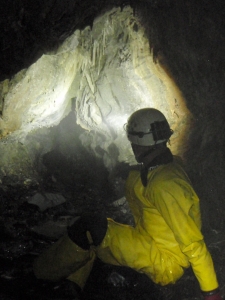
A man in a yellow waterproof suit and hard hat is sat on the ground. He is shining a torch into a limestone cave.

Researcher Lee Knight in the lower stream passage of Uamh nan Claig-Ionn, Appin. Photo by Dominika Wroblewska.

Although surveys like this have been carried out for the rest of the British Isles, this was the first of its kind in Scotland.

Between 2015 and 2021, the researchers sampled streams, sumps and pools within the caves, using sweep or kick sampling and pond-nets. The sites in this study included the famous Smoo Cave in Sutherland, and others across Assynt, Wester Ross, Skye, Argyll and in Perthshire. The longest caves sampled were those in the dolomitic limestones of the Durness Group (more than 1km in length), and they also sampled some of the more than 150 caves found in the Neoproterozoic Dalradian Supergroup metalimestones, the longest being near Appin.

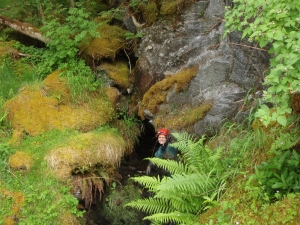
A woman in a red hard hat looks up from the entrance of a cave. The cave is surrounded by lush ferns and moss.

Researcher Dominika Wroblewska at the entrance to Uamh an Tobair Dhuibh, in Appin. Photo by Lee Knight.

Their results were impressive, finding over 130 different species within cave systems, the majority of them in Assynt, Appin and Skye.
Most species were stream dwellers washed into the caves from above ground, which was no surprise: thanks to our copious rainfall and the often steep rough landscape, Scotland’s caves experience a healthy throughput of water either by inflowing streams, or percolating drips from the rocks above.
These species included dragonfly nymphs and caddis fly, but the team also encountered water crickets, aquatic snails, pea mussels and crustaceans.
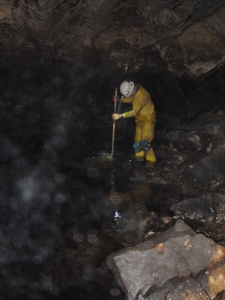
A man in a yellow waterproof suit and a hard hat stands in a cave. He is in knee-deep water and is sampling the water using a long handled net.

Researcher Lee Knight sampling in The Lake in Landslip Chamber in Cnoc nan Uamh, Assynt. Photo by Eszter Domina.

Species that live entirely below ground are known as stygobitic, and it is thought that stygobitic species of crustaceans in the UK either recolonised our caves following their extinction during the ice ages, or were able to survive beneath the ice sheets, and subsequently dispersed.

Entirely subterranean crustaceans have been found in other parts of the British Isles, but excitingly one of the ostracod species found in this study, in Allt nan Uamh Stream Cave and Smoo Cave, could be the first record of this particular stygobitic species in the British Isles.

To read more about this study and the results, take a look at the paper by Knight et al. 2022.

by Elsa Panciroli

Monitoring a geological Site of Special Scientific InterestThe Scottish Geology Trust is keen to work with volunteers and NatureScot to help protect Scotland’s geological sites of national and local importance. In a recent seminar, Dr Rachel Wignall from NatureScot explained the background of the national network of Sites of Special Scientific Interest and Geological Conservation Review sites, and what is currently being done to monitor these sites. She set out how volunteers could get involved in contributing information about the condition of sites.
Watch the seminar presentation on our YouTube Channel

Currently, NatureScot welcome comments and observations about the condition of any geosite, and these can be emailed to NatureScot staff. However in discussion after the presentation, it was agreed it would be useful to develop a system that would make it easy for comments and photographs to be collected through an online platform, where information could be viewed publically, responded to, and passed on as appropriate. And to promote this system and recruit volunteers to get involved. The Scottish Geology Trust is keen to take forward a project to do this, if you are interested please contact Angus Miller.

Find out more:

Sites of Scientific Interest in Scotland | Geological Conservation Review Sites in Scotland

Search for Geosites on the Sitelink map

Geoconservation in Scotland – Online training course on Local Geodiversity Sites, organised by the Scottish Geology Trust and GeoConservation UK, May 2021

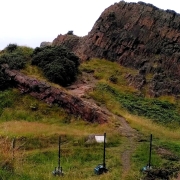
The Scottish geological community have written to Alex Paterson, Chief Executive of Historic Environment Scotland, suggesting that the temporary fence closing off the Radical Road in Holyrood Park in Edinburgh should be moved to allow access to Hutton’s Section, Edinburgh’s most important geological site. James Hutton is known internationally as the founder of modern geology, and enthusiasts from across the UK and around the world come to Edinburgh to visit sites associated with James Hutton. This interest is likely to increase as we approach the tercentenary of Hutton’s birth in 2026. In addition the Park is used routinely for student field trips from the Universities of Edinburgh, Glasgow and many other institutions.

Following rockfall from Salisbury Crags in 2018, the Radical Road along the base of the crags has been closed. It is likely to remain closed for some time, as Historic Environment Scotland assess options for allowing safe access to this historic path. However, Hutton’s Section is close to the edge of this restricted area, on a section of Salisbury Crags that has been assessed as having a lower risk of rockfall. The letter from various geological organisations and interested individuals suggests that the temporary fence could be re-located to the north end of Hutton’s Section, so that there is unrestricted access to Hutton’s Section.


Hutton’s Section, located in the low cliff in the centre of the photo, is currently inaccessible, behind a temporary fence installed by Historic Environment Scotland to prevent access to the Radical Road. Photo: Angus Miller.

Lochaber Geopark Visitor Centre

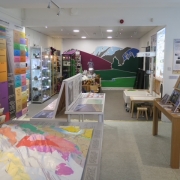
Lochaber Geopark are looking for volunteers to help staff their Visitor Centre at 55A Fort William High Street (near Cameron Square). The Visitor Centre attracts more than 30,000 visitors a year, from the UK and overseas. The Centre opens on weekdays at 10 am and closes at 4 pm.

Volunteers could work full or part-time and would mostly sit at a well-illuminated desk, with Perspex screens, near the entrance. They would be responsible for a £1 ‘pay-on-entry’ system and for sales of books, maps and craft items. The Centre includes a children’s area with an ‘i-Sandbox’ that sometimes requires supervision. There is space for a volunteer to work at the desk using a laptop during quiet periods.

The displays describe the geological history of Lochaber from very ancient to recent times, and include rocks, minerals and fossils. Two TV screens illustrate the geology of Lochaber, local history and outdoor activities. Knowledge of Geology is not required, but enthusiasm to speak to visitors to the area and share suggestions for scenic locations and routes in Lochaber would be valuable.

After they have gained experience some volunteers could be asked to work alone and open and/or close the Centre themselves. There is an upstairs office with a small kitchen and toilet.

For more information please email: ian.parsons@ed.ac.uk or phone 01397 747 255 (evenings).

Are you always picking up stones? The Scottish Geology Trust has launched a campaign called Pieces of Scotland this summer inviting everyone to share their favourite #PiecesOfScotland with us on social media! From #staycation beach pebbles on your windowsill, to beloved museums displays, we would love for you to show us the Scottish rocks that have captured your heart.

Many geologists who studied at UK universities, and many from elsewhere who have been on fieldtrips to the NW Highlands, will have stayed at the Inchnadamph Lodge. Over the years it has become somewhat of an iconic place to stay while working in the Highlands. Earlier this year the NWH Geopark learned that the owner is planning to sell the lodge in the coming year and that a number of hotel chains are interested in purchasing it.

Arran Geopark has gathered three film crews together with many enthusiastic Arran experts to create three films focussed on the geology, archaeology, and ecology of the island. The films seek to bring together and highlight these distinct “ologies” and thus the concept of “Arranology” was formed.

The Arranology project was funded by Highlands and Islands Enterprise with an additional contribution from the Arran Trust; enabling Arran Geopark to create the trilogy of short films celebrating Arran.

Malcolm Wilkinson, Coordinator of Arran Geopark said: “These wonderful films celebrate the amazing landscape, biodiversity and heritage of our small island – and this is exactly what Geoparks all around the world are there to do”.

View the films here: https://www.ArranGeopark.co.uk/Arranology/

Sheila Gilmore, Chief Executive of VisitArran, said: “These films will encourage everyone visiting our beautiful island to delve further into the island’s environmental past, and appreciate aspects that they may have been unaware of. Arran Geopark, and indeed all involved, are to be congratulated on the whole concept of Arranology”