The Scottish Geology Trust has formed a partnership with the Geological Society of London and the British Geological Survey to lead a bid to bring the 38th International Geological Congress (IGC) to Glasgow in 2028.
 The IGC is the longest-running meeting place for earth scientists from across the world, indeed is one of the world’s oldest international conferences in any science. Beginning in 1878 and held every four years, the IGC is likened to the Olympics for Earth Sciences and is similarly awarded through a competitive bidding process. It is the flagship event for the International Union of Geological Sciences (IUGS) and was last held in the UK in 1948. IGCs bridge academic professionals, national organisations including geological surveys, and key industries – and is one of the major international science conferences in the calendar. For us, it provides a great opportunity to promote the stunning geology of Scotland, its great geodiversity, and heritage along with the role of our science in servicing the modern world.
Our vision for Glasgow 2028 is: “Geoscience delivers a sustainable and equitable future”. It places our science at the heart of the transition to new energies, the development of earth resources necessary to meet society’s needs and the increasing our resilience to environmental change. We are building on Glasgow’s hosting of COP26 (2021) and Scotland’s 250-year history of geological science in the service of society, Glasgow is an ideal venue to share not only breaking scientific advances but also lessons from history – debating their application for all humanity’s benefit. Our Congress vision maximises equality, diversity, inclusion and accessibility through its planning and delivery, and welcomes participants from all parts of the world. Glasgow is a great place for a conference – famous for its open, welcoming vibe, excellent value and close proximity, not only to Scotland’s fantastic cultural heritage but also its exceptionally diverse geology.
The 38th IGC will run for a week in late summer 2028. Alongside the main scientific conference, we will offer a fantastic range of excursions for our participants along with outreach and educational events for the public at large, whether they be residents of Glasgow or elsewhere across Scotland, visitors and, through both virtual events and legacy resources, to those unable to be present in person.
Our bid for the 38th IGC is supported from across the community, from Scotland’s First Minister, through public agencies, organisations, the broad education sector, learned societies and industry. Bids to host are submitted to the IUGS by end March 2024, with a decision taken at the upcoming 37th IGC (Busan, Republic of Korea) in August 2024.
You can find out more about our bid at igc2028glasgow.org. If you would like to support the bid, please email: igc2028@geolsoc.org.uk.

Scotland Holds Secrets of Snowball Earth
We’re all familiar with the idea of an ice age, during which the Earth’s climate cools, and we lurch between glacial and interglacial periods. The concept of a global ice age is maybe more difficult to fathom. Imagine the Earth almost completely covered in ice during the longest and most severe ice age in the planet’s history!
‘Snowball Earth’ aptly describes this global ice age, the Cryogenian Period, that started 720 million years ago and lasted millions of years. The suggestion that this time was followed by an ‘explosion’ of life is also quite intriguing. Why did this happen, and what were the circumstances during that global glaciation and subsequent deglaciation that set the scene for the expansion of life on our planet?
A new study by masters student Elias Rugen and his colleagues, published in the Journal of the Geological Society of London, has documented brand new evidence for the age of a ‘snowball Earth’ right here in Scotland. The Port Askaig Formation is found only in Scotland and Ireland, and in Scotland is best seen as a 1.1 km thick layer of glacial and non-glacial deposits on the Garvellach Islands. This tiny archipelago lies off the coast of Argyll, just beyond the Slate Islands. The authors used an age-dating technique that relates the proportions of naturally occurring uranium and its decay product lead, in zircon. They also provide a useful summary of the current understanding of the Port Askaig Formation and ‘snowball Earth’ that is really worth reading.
We are now waiting to hear whether the amazing geological events preserved in the Port Askaig Formation will earn it the coveted ‘Golden Spike’; a Global Boundary Stratotype Section and Point (GSSP) that is internationally recognised as defining the lower boundary of a stage on the geologic time scale. These discoveries clearly demonstrate the unique and special character of Scotland’s geological history!
You can read the study here.
By Maureen Whalen
Scotland at the heart of Stonehenge
Here at the Scottish Geology Trust, we are very proud to promote our geology with the rest of the UK and wider world, through activities such as the Scottish Geology Festival and the bid to bring the International Geological Congress to Glasgow. There have recently been some human history pieces about Scottish geology, such as the Ross of Mull granite and Scottish slate, that have been been of huge interest globally.
True to form, a new study of source areas for the megaliths that make up Stonehenge raises more questions than it answers!
Geologist Anthony Clarke and a team from Australia, Aberystwyth and University College London, through some impressive geological detective work, have found that unlike the other megaliths, the Altar Stone is likely to have been sourced not from England or even Wales, but from Scotland. These ‘geo-detectives’ looked at mineral grains collected from fragments of the Altar Stone. Their analysis of the age and chemistry of detrital zircon, apatite and rutile grains found in these fragments indicated a very good match to the Old Red Sandstone of the Orcadian Basin in northeast Scotland, about 700 km north of Stonehenge. You can read this study here – https://www.nature.com/articles/s41586-024-07652-1#Sec5
Once again, human ingenuity, as well as Scotland’s geology, surprises and challenges us!
By Maureen Whalen
Scottish Geology Festival 2024
We are excited to announce that the Programme for this year’s Scottish Geology Festival is now live and available here on our website! The Scottish Geology Trust and partners are delighted to offer a packed programme of events and activities across the country and online from the 1st September until 6th October 2024, showcasing and celebrating Scotland’s unique geology.
From guided walks at Hopetoun, Kinghorn, Knockan Crag and Siccar Point, to exploring the geology of Angus with Arbroath Signal Tower Museum, to discovering the beach pebbles of Dunure, St Cyrus and Rosemarkie, to Earth Made: A geology inspired creative collective – we hope there is something for everyone to enjoy. And there’s plenty more events in the pipeline so don’t forget to check in with the Festival listings and our social media for updates.
Festival Launch Event: Women on the Rocks: Pioneers of Scottish geology
To celebrate the Launch of the 2024 Festival, the Scottish Geology Trust, The Hunterian and Kelvin Hall are proud to host “Women on the Rocks: Pioneers of Scottish geology” an evening lecture in Kelvin Hall (Glasgow) and online (via zoom) on the 28th August, 6:30pm. Join us to explore the history of women in geology, and learn about some of Scotland’s pioneering women geologists whose work has made significant contributions to our understanding of Earth’s processes.
Further information and booking.
The Geology of Scotland, 5th edition
Although a small country, Scotland’s geology is complex, internationally renowned and offers an accessible outdoor research laboratory and training ground for earth science. The onshore and offshore geology together encompass examples of all Earth’s geological periods and preserve many classic examples of sedimentary basins and orogenic belts. Palaeontological findings have provided key evidence for the evolution of life.
With a wide spectrum of contributors, full-colour figures and photographs and, for each chapter, a Topic Box highlighting key research developments and challenges, this 5th edition of The Geology of Scotland represents a major update and expansion from the 4th edition.
A revised Introduction summarizes the geological evolution of Scotland, the nature of the crust and the societal relevance of geology to climate change and sustainability. The final three chapters provide a modern view on energy, water and minerals, environmental concerns and geoconservation. The intervening chapters cover the geological periods, including much new geochronological data and exciting new palaeontological discoveries.
Further information & purchase details for The Geology of Scotland 5th edition
New Eco-Museum of Scottish Mining Landscapes
The Eco-museum takes inspiration from the Landscape Legacies of Coal app, previously created by Dr Mills, which enabled users to follow a series of co-produced and curated heritage walks, primarily across Stirling and Clackmannanshire, that narrated the story of Scottish coal through the rich and extensive medium of landscape and the lens of local communities.
For this new project SGT has teamed up Dr Mills, along with the National Mining Museum Scotland, the Museum Friends, the Botanical Society of Britain and Ireland, and community artist Yvonne Weighhand Lyle to create 15 new ‘landscape journeys’.
These routes will include a focus on geology, ecology and landscape inspired art, as well as emphasising the role of former colliery sites in combatting the use of fossil fuels, through the redevelopment for geothermal, wind and solar farms and the forestation of bings for carbon sinks.
The virtual museum will focus on the Scottish Midland coalfield which spans an area from Fife to Ayrshire, with visitors able to download new cycling and walking routes created by local communities to both commemorate their mining history, heritage, and a sense of place.
The project will be officially launched at the National Mining Museum Scotland in late Spring. The National Lottery Heritage Fund is supporting the Eco-Museum project with £63,784 thanks to National Lottery players.
More information can be found on the University of Stirling website www.stir.ac.uk/news/2024/february-2024-news/new-museum-to-celebrate-scottish-mining-landscapes/ and you can keep up to date via the Landscape Legacies Facebook page (www.facebook.com/landscapelegaciesofcoal) and twitter/X (x.com/coal_legacies?s=21).
Any community groups or individuals interested in participating in the project should contact Dr Catherine Mills: c.j.mills@stir.ac.uk or Dr Katie Strang: engagement@scottishgeologytrust.org
Bringing the International Geological Congress to Scotland
The Scottish Geology Trust has formed a partnership with the Geological Society of London and the British Geological Survey to lead a bid to bring the 38th International Geological Congress (IGC) to Glasgow in 2028.
Our vision for Glasgow 2028 is: “Geoscience delivers a sustainable and equitable future”. It places our science at the heart of the transition to new energies, the development of earth resources necessary to meet society’s needs and the increasing our resilience to environmental change. We are building on Glasgow’s hosting of COP26 (2021) and Scotland’s 250-year history of geological science in the service of society, Glasgow is an ideal venue to share not only breaking scientific advances but also lessons from history – debating their application for all humanity’s benefit. Our Congress vision maximises equality, diversity, inclusion and accessibility through its planning and delivery, and welcomes participants from all parts of the world. Glasgow is a great place for a conference – famous for its open, welcoming vibe, excellent value and close proximity, not only to Scotland’s fantastic cultural heritage but also its exceptionally diverse geology.
The 38th IGC will run for a week in late summer 2028. Alongside the main scientific conference, we will offer a fantastic range of excursions for our participants along with outreach and educational events for the public at large, whether they be residents of Glasgow or elsewhere across Scotland, visitors and, through both virtual events and legacy resources, to those unable to be present in person.
Our bid for the 38th IGC is supported from across the community, from Scotland’s First Minister, through public agencies, organisations, the broad education sector, learned societies and industry. Bids to host are submitted to the IUGS by end March 2024, with a decision taken at the upcoming 37th IGC (Busan, Republic of Korea) in August 2024.
You can find out more about our bid at igc2028glasgow.org. If you would like to support the bid, please email: igc2028@geolsoc.org.uk.
Annual General Meeting
So this is a great chance to join the Scottish Geology Trust, and to come to the AGM to find out more about our work! As well as reviewing last year’s activities, including the Scottish Geology Festival and the Geosites Project, we will be looking forward and making plans for the rest of 2024.
New book on Shetland Geology
Shetland Geological Society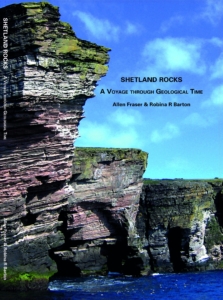 have published the first comprehensive account of Shetland’s geological story, complete with a gazetteer of key sites. The new book, Shetland Rocks: a voyage through geological time is written by Allen Fraser and Robina Barton.
The book is available by mail order for £24.69. Contact info@shetlandgeolsoc.org.
New edition of Earth Heritage features lots of interesting Scottish geology news!
Earth Heritage is a free publication, produced twice-yearly by the Geologists’ Association, Natural England, Natural Resources Wales, NatureScot and the Quaternary Research Association. It can be downloaded as a pdf file from www.earthheritage.org.uk.
New Geosites Project
Scotland has over 1000 sites that are designated as important for geology and geomorphology at a national or local level, but the value and importance of these sites is often not recognised, it is hard to find information about them and systematic monitoring is under-resourced.
The Scottish Geology Trust’s new Geosites project aims to work with partners to bring information about all these sites together in a single interactive map and database, that makes it easy for people to report issues with sites, and to share information. We will support a network of volunteer ambassadors, available to help engage with local communities in learning and benefiting from their local geoheritage.
The Geosites project pilot phase is now underway. We have created a new map of all of Scotland’s Geological Conservation Review sites (geosites.scottishgeologytrust.org), and volunteers are visiting at least 100 sites to gather additional data and photographs and contribute to an information page for each site. We will review the pilot phase and report back to funders by the end of 2023.
This phase of the project has been supported by funding from the following organisations:
The Curry Fund of the Geologist’s Association
Geological Society of Glasgow
Edinburgh Geological Society
The Quaternary Research Association
If you would like to contribute to the Geosites project as a volunteer, or find out more about the project, please contact Angus Miller (angus@scottishgeologytrust.org).