
Scotland Holds Secrets of Snowball Earth
 The phrase ‘snowball Earth’ brings to my mind a giant snow globe, with the gentle swirl of snowflakes serenely floating within the confines of the globe. I’m not sure any living being experiencing the many ice ages our world has seen would characterise the climate of those times as ‘gentle’ or ‘serene’. Nevertheless, such events have shaped our world, particularly the landscapes of Scotland.
We’re all familiar with the idea of an ice age, during which the Earth’s climate cools, and we lurch between glacial and interglacial periods. The concept of a global ice age is maybe more difficult to fathom. Imagine the Earth almost completely covered in ice during the longest and most severe ice age in the planet’s history!
‘Snowball Earth’ aptly describes this global ice age, the Cryogenian Period, that started 720 million years ago and lasted millions of years. The suggestion that this time was followed by an ‘explosion’ of life is also quite intriguing. Why did this happen, and what were the circumstances during that global glaciation and subsequent deglaciation that set the scene for the expansion of life on our planet?
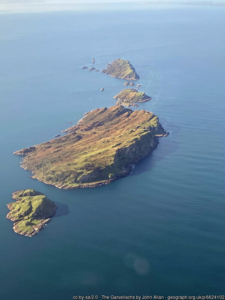
A new study by masters student Elias Rugen and his colleagues, published in the Journal of the Geological Society of London, has documented brand new evidence for the age of a ‘snowball Earth’ right here in Scotland. The Port Askaig Formation is found only in Scotland and Ireland, and in Scotland is best seen as a 1.1 km thick layer of glacial and non-glacial deposits on the Garvellach Islands. This tiny archipelago lies off the coast of Argyll, just beyond the Slate Islands. The authors used an age-dating technique that relates the proportions of naturally occurring uranium and its decay product lead, in zircon. They also provide a useful summary of the current understanding of the Port Askaig Formation and ‘snowball Earth’ that is really worth reading.
We are now waiting to hear whether the amazing geological events preserved in the Port Askaig Formation will earn it the coveted ‘Golden Spike’; a Global Boundary Stratotype Section and Point (GSSP) that is internationally recognised as defining the lower boundary of a stage on the geologic time scale. These discoveries clearly demonstrate the unique and special character of Scotland’s geological history!
By Maureen Whalen

