
Scotland at the heart of Stonehenge
Here at the Scottish Geology Trust, we are very proud to promote our geology with the rest of the UK and wider world, through activities such as the Scottish Geology Festival and the bid to bring the International Geological Congress to Glasgow. There have recently been some human history pieces about Scottish geology, such as the Ross of Mull granite and Scottish slate, that have been been of huge interest globally.
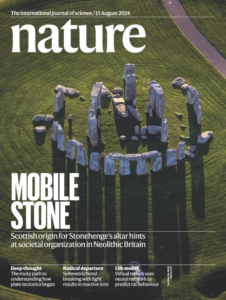 It was a little bit of a surprise, however, to find that the central recumbent sandstone block or megalith (aka the Altar Stone) of England’s famous Stonehenge actually came from Scotland! Stonehenge has captured our imagination for generations. Scientists, artists, tourists and even protestors have been drawn to its mysteries and fame, and have sought to discover its secrets. Geologists have now taken another look at this infamous stone circle – after all, isn’t that the purpose of science, to ask questions, find some answers and then, always insatiably curious, ask some more?
True to form, a new study of source areas for the megaliths that make up Stonehenge raises more questions than it answers!
Geologist Anthony Clarke and a team from Australia, Aberystwyth and University College London, through some impressive geological detective work, have found that unlike the other megaliths, the Altar Stone is likely to have been sourced not from England or even Wales, but from Scotland. These ‘geo-detectives’ looked at mineral grains collected from fragments of the Altar Stone. Their analysis of the age and chemistry of detrital zircon, apatite and rutile grains found in these fragments indicated a very good match to the Old Red Sandstone of the Orcadian Basin in northeast Scotland, about 700 km north of Stonehenge. You can read this study here – https://www.nature.com/articles/s41586-024-07652-1#Sec5
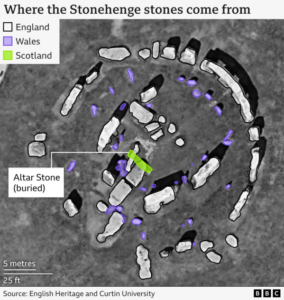 The Altar Stone is the largest of the ‘bluestones’, weighing a whopping 6 tonnes. The authors believe it was probably moved by sea, which is really an astonishing thought. The time, effort, and communication needed to transport such a large rock from Scotland to the south of England is not something most of us would have even thought possible for people living 5,000 years ago.
Once again, human ingenuity, as well as Scotland’s geology, surprises and challenges us!
By Maureen Whalen

