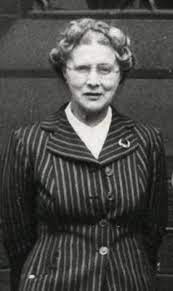
Ethel Currie 1899 – 1963
Ethel Dobbie Currie was a geologist and palaeontologist born in Glasgow, who spent her professional career at The University as a curator at The Hunterian Museum. She was one of the first women to be made a Fellow of the Royal Society of Edinburgh (1949), the first woman to receive their Neill Prize (1945), and the first woman President of the Geological Society of Glasgow (1952).
Originally from Glasgow, Currie graduated from the University of Glasgow under Professor J. W. Gregory in 1920. She then undertook her PhD while working as an assistant curator of the geological collections at the Hunterian Museum under Dr William Smellie. She administered the collections and prepared exhibits, as well as undertaking research and lecturing. She was also awarded an honorary doctorate from the University in 1945, and promoted to the grade of Senior Lecturer at the University of Glasgow in 1960, shortly before retirement.
Currie worked on many of the fossils held in the collections at The Hunterian, including Mesozoic and Tertiary sea urchins from Africa and southern Asia. Perhaps her most significant work was on ammonoids – she described every known species and variety of Scottish goniatite, an early branch of ammonite relatives that appeared in the Devonian and became extinct at the end of the Permian – which was of major importance to understanding the Carboniferous stratigraphy of Scotland. She also described Mesozoic corals, and rock specimens from the Silurian. In her later years, she also became interested in fossil vertebrates.
Selected papers
Clark, N.D., 2008. Working with fossils at the Hunterian Museum: a glimpse into the lives of John Young, John Young and Ethel Currie.
Currie, L. D. 1927. On Cyamocephalus, a new synxiphosurine from the Upper Silurian of Lesmahagow, Lanarkshire. Geological Magazine. 64, 153–157.
Currie, E.D., 1927. XVIII.—Jurassic and Eocene Echinoidea from Somaliland. Earth and Environmental Science Transactions of The Royal Society of Edinburgh, 55(2), pp.411-441.
Gregory, J.W. and Currie, E.D., 1928. The Vertebrate Fossils from the Glacial and Associated Post-Glacial Beds of Scotland in the Hunterian Museum, University of Glasgow, and their Evidence on the Classification of the Scottish Glacial Deposits (Vol. 11). Jackson, Wylie and Company.
About Hutton…
R. L. Stevenson:
“Hutton the geologist, in quakerish raiment, looking altogether trim and narrow, as if he cared more about fossils than young ladies.”
John Playfair:
“His figure was slender, but indicated activity; […] His eye was penetrating and keen, but full of gentleness and benignity.”
“His conversation was inestimable; as great talents, the most perfect candour, and the utmost simplicity of character and manners, all united to stamp a value upon it. He had, indeed, that genuine simplicity, originating in the absence of all selfishness and vanity, by which a man loses sight of himself altogether, and neither conceals what is, not affects what is not…”
“A brighter tint of gaity and cheerfulness spread itself over every countenance when the Doctor entered the room…”
“With this exquisite relish for whatever is beautiful and sublime in science, we may easily conceive what pleasure he derived from his own geological speculations. […] to him they were matter, not of transient delight but of solid and permanent happiness.”